gpslog — location MCP
Two small programs plus one SQLite file:
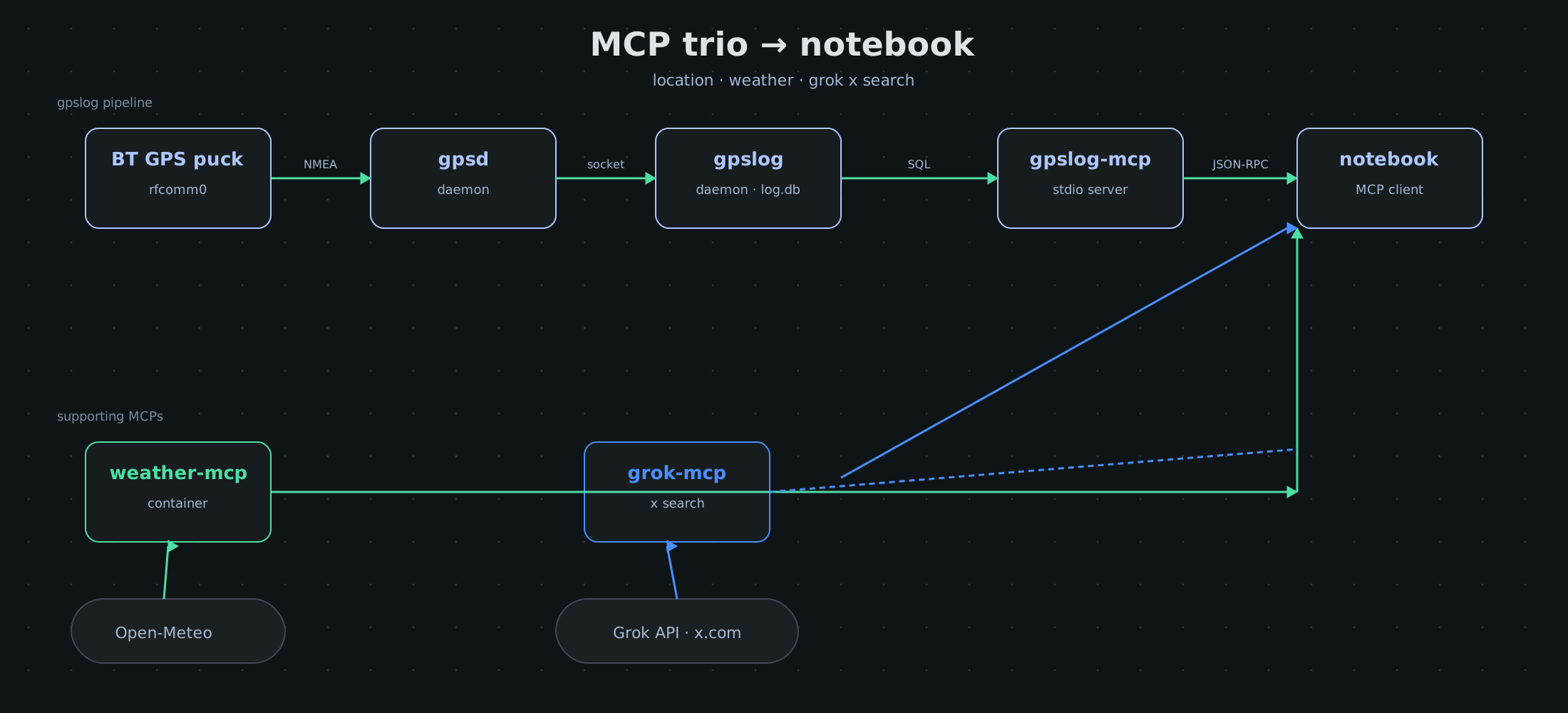
The daemon subscribes to gpsd on loopback, parses TPV
JSON, downsamples, and appends fixes. The MCP server opens the same
file read-only (WAL mode so writer and reader share it
without locks) and exposes five location.* tools over
JSON-RPC newline-delimited stdio.
The five tools
- location.currentmost recent fix within
max_age_s(default 300) - location.atnearest fix to
tswithinmax_age_s - location.nearbbox prefilter + Haversine refine, sorted by ts
- location.visitscluster contiguous in-radius runs ≥
min_duration_s - location.timelineone fix per
downsample_sbucket
Problems overcome
- Gulf of Guinea
gpsdemits(0.0, 0.0)before first lock — one line in the downsampler drops it. - Status pingsTPVs with
mode < 2have no real fix; gpsd sends them anyway. Dropped early. - Stationary phonesNo movement = no fixes = visit detection breaks. Solved by a 60 s anchor floor — one row per minute when still, so "parked for 2 hours" looks different from "phone was off."
- Stdout is sacredMCP speaks JSON over stdout. All logging is routed to stderr — silence required.
- Never raise on configMissing file → defaults. Malformed TOML → warning on stderr + defaults. Wrong-typed field → warning + default for that field only.
Tool errors come back as readable results
Any tool exception is caught and converted to
{isError: true, content: [{type:"text", text: …}]} so
an LLM can recover instead of seeing a transport-level
error. The run keeps going.
Weather forecast MCP
A tiny stdio MCP server that wraps Open-Meteo. Three tools:
weather.current, weather.forecast,
weather.hourly. Each one takes a latitude / longitude
(or the string "here" which resolves via the
gpslog MCP companion tool). Responses cache to disk
for 15 minutes so a hot notebook doesn't hammer the API.
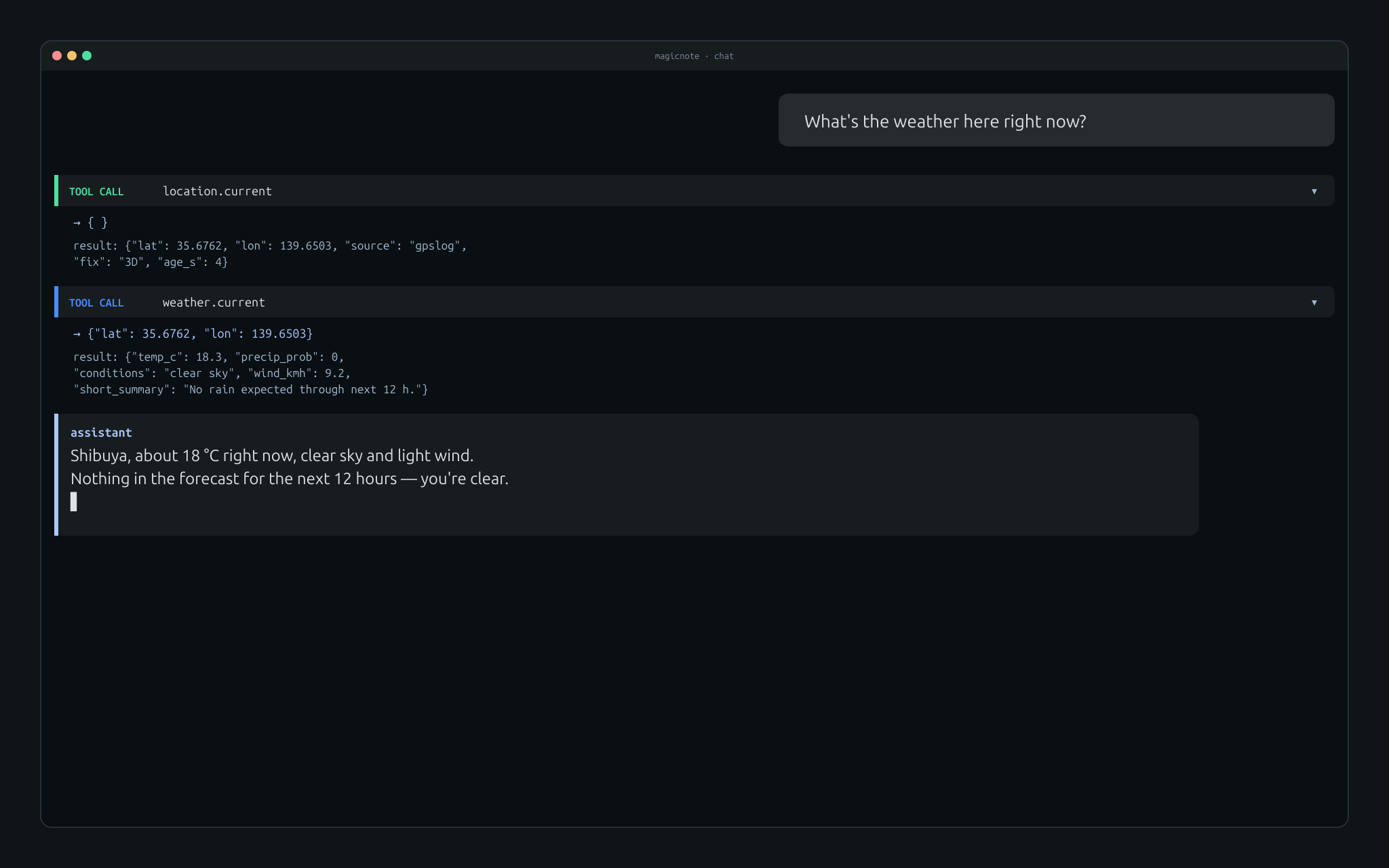
The notebook's notebook spell grants
gpslog.location.current + weather.* in
the same allowlist — ask "what's the weather?" and the model chains
them without being told.
Grok X search MCP
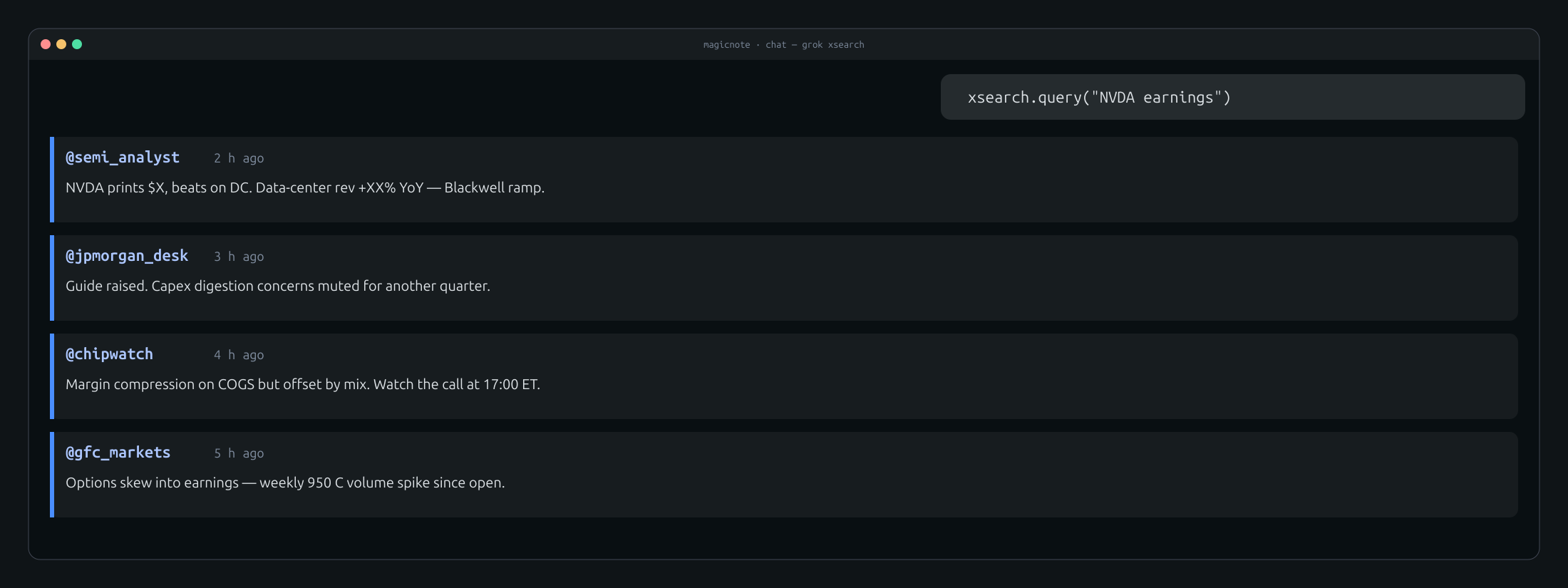
A stdio MCP server that proxies the Grok API for live X searches.
One tool — xsearch.query(query, limit?, since?) — returns
a list of posts with author, timestamp, and body. Powers the
notebook's "what are people saying right now about …" moments.
Rate-limit aware (429 → exponential backoff). API key loaded from an env var, never logged. Failure responses come back as structured tool errors so the notebook can fall back to a plain web search if the Grok API is down.
Three small tools > one big one
None of these servers is interesting on its own. What they enable — a notebook that knows where you are, what the weather's doing, and what's happening on X — is only interesting together. This is the shape of useful MCP work: small verbs that compose in the agent's head.